Nevro Corporation revolutionized the industry with its HF10 and HFX spinal cord stimulation devices, introducing groundbreaking 10 kHz high-frequency technology that promised pain relief without the tingling sensations traditionally associated with these systems.
These FDA-approved devices were marketed as superior alternatives for managing chronic back pain, leg pain, diabetic neuropathy, Complex Regional Pain Syndrome, failed back surgery syndrome, and other debilitating conditions.
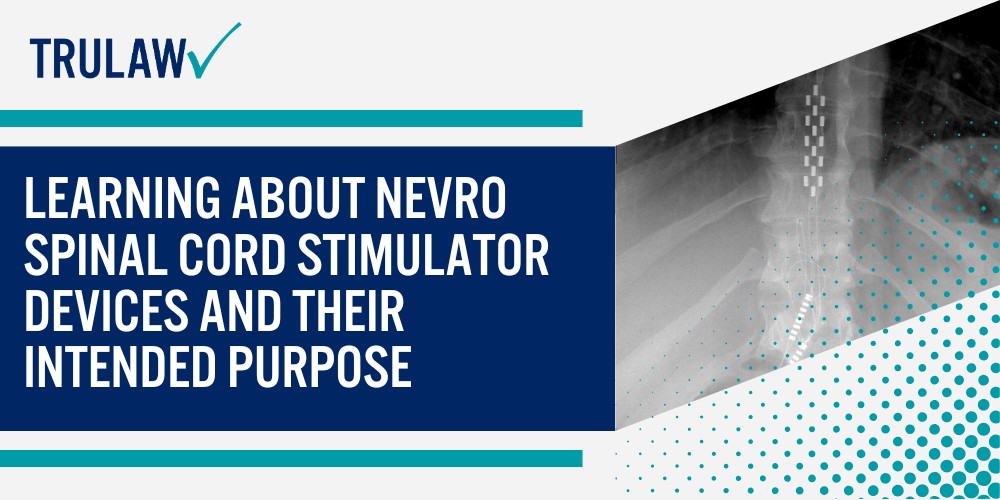
The company’s proprietary technology operates at 10,000 Hz, dramatically different from conventional low-frequency stimulators that typically function below 1,200 Hz.
This section examines the technology, regulatory approvals, and market positioning of these devices that have now become the subject of serious legal concerns.
How Do the Nevro HF10 and HFX Spinal Cord Stimulator Work?
Nevro’s spinal cord stimulation technology represents a fundamental departure from traditional pain management devices through its unique high-frequency approach.
The HF10 and HFX systems deliver electrical pulses at 10,000 Hz directly to the spinal cord, interrupting pain signals before they reach the brain through low amplitude (1-5 mA) and short pulse width (30 μS) parameters.
Unlike conventional stimulators that create paresthesia (a tingling or buzzing sensation that masks pain) Nevro’s technology targets inhibitory neurons in the dorsal horn to provide pain relief without any sensation.
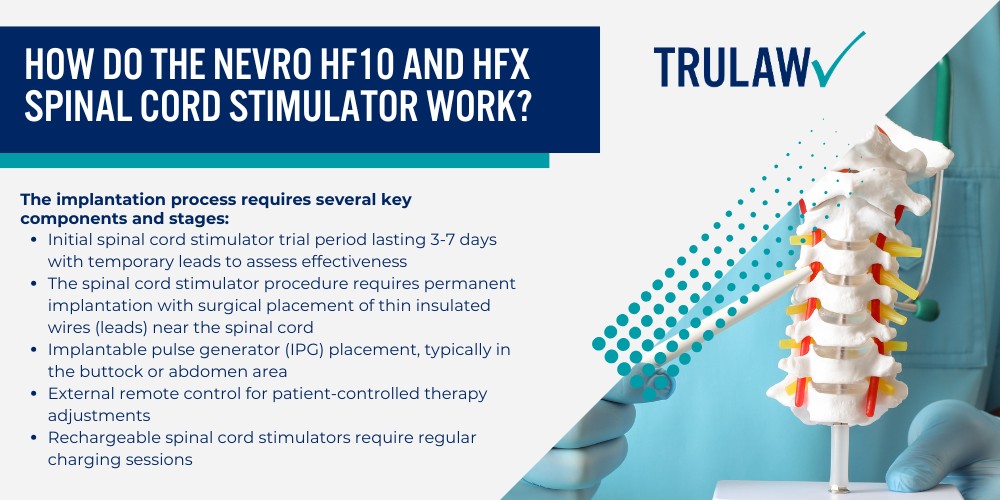
The implantation process requires several key components and stages:
- Initial spinal cord stimulator trial period lasting 3-7 days with temporary leads to assess effectiveness
- The spinal cord stimulator procedure requires permanent implantation with surgical placement of thin insulated wires (leads) near the spinal cord
- Implantable pulse generator (IPG) placement, typically in the buttock or abdomen area
- External remote control for patient-controlled therapy adjustments
- Rechargeable spinal cord stimulators require regular charging sessions
Clinical studies, particularly the pivotal SENZA-RCT trial published in Anesthesiology journal, demonstrated that HF10 therapy achieved superior outcomes compared to traditional spinal cord stimulation.
The study reported that 84.5% of back pain patients and 83.1% of leg pain patients experienced significant pain relief with HF10 therapy, compared to only 43.8% and 55.5% respectively with traditional SCS.
The paresthesia-free feature was considered revolutionary because it allowed patients to drive, sleep, and perform daily activities without the constant tingling sensation that many found uncomfortable or limiting.
The device’s rechargeable battery system was designed to last 10-25 years, considerably longer than non-rechargeable alternatives that require replacement every 3-5 years.
This longevity, combined with the promise of superior pain relief without side effects, made Nevro’s technology particularly attractive to patients seeking long-term solutions to manage chronic pain.
FDA Regulatory History and Approval Process
The path to market for Nevro’s spinal cord stimulators involved rigorous evaluation through multiple clinical trials and the FDA’s Premarket Approval (PMA) process, the most stringent regulatory pathway for Class III medical devices implanted in patients.
The FDA classifies spinal cord stimulators as Class III devices, requiring manufacturers to demonstrate safety and effectiveness through extensive clinical trials before marketing.
Nevro received initial FDA approval for its Senza system in May 2015, marking the first high-frequency spinal cord stimulator authorized for use in the United States.
The landmark SENZA-RCT (Randomized Controlled Trial) study served as the cornerstone for FDA approval, involving 198 patients across multiple centers who were randomized to receive either HF10 therapy or traditional low-frequency stimulation.
The results showed not only superior pain relief but also a favorable safety profile, with no reports of neurological deficits directly attributable to the stimulation.
This evidence convinced FDA reviewers that the novel 10 kHz frequency posed no additional risks compared to conventional devices.
Subsequent FDA approvals substantially expanded Nevro’s market reach:
- July 2021: FDA approval for treating painful diabetic neuropathy (PDN), making it the first spinal cord stimulation system authorized for this indication
- October 2022: Approval of the HFX iQ system incorporating artificial intelligence to personalize therapy
- Multiple supplemental approvals for enhanced features and expanded MRI compatibility
However, the broader spinal cord stimulator industry has faced increasing scrutiny from regulators.
While the FDA has not issued a specific safety communication regarding Nevro devices, the agency has raised concerns about spinal cord stimulators generally.
Medical device industry data reveals troubling patterns, with tens of thousands of adverse event reports filed annually for various manufacturers’ devices.
These reports document issues ranging from device malfunctions to serious neurological injuries, highlighting the gap between clinical trial results and real-world outcomes.
The FDA’s medical device reporting system continues to monitor post-market safety data, requiring manufacturers to report serious adverse events.
This ongoing surveillance has revealed that complications may be more common than initially understood, raising questions about whether medical device manufacturers adequately captured long-term risks in pre-market trials.
Market Position and Competition in the Spinal Cord Stimulation Industry
Nevro established itself as a major player in the global spinal cord stimulation market, competing against burst stimulation devices and other technologies through aggressive marketing of its proprietary 10 kHz approach.
The company’s HF10 and HFX systems competed directly with dorsal root ganglion stimulators, Infinity deep brain stimulators, and devices from Boston Scientific, Abbott, and Medtronic in a market experiencing growth driven by the chronic pain epidemic.
Industry analysts estimate the global spinal cord stimulation market exceeded $2.5 billion in recent years, with projections for continued expansion as more patients seek alternatives to opioid medications.
Nevro differentiated itself from competitors through several strategic advantages:
- Paresthesia-free therapy as the primary advantage over traditional systems
- Superior clinical outcomes based on the SENZA-RCT study data
- Advanced features including full-body MRI compatibility
- Longest-lasting rechargeable battery technology in the industry
- Proprietary waveform parameters protected by extensive patent portfolio
The competitive landscape intensified through patent disputes, most notably with Boston Scientific, which alleged that Nevro infringed on its spinal cord stimulation technology patents.
These legal battles culminated in settlements and cross-licensing agreements, demonstrating the high stakes involved in controlling innovative pain management technologies.
The patent disputes also revealed the substantial investments companies make in developing and protecting their intellectual property in this lucrative market.
Marketing materials heavily promoted Nevro’s devices as revolutionary solutions that could relieve pain and “liberate” patients from chronic conditions, using patient testimonials and clinical data to support superiority claims.
The company’s direct-to-consumer advertising campaigns featured messages about regaining active lifestyles and reducing dependence on pain medications, particularly resonating with patients who had failed other treatments (painting a spinal cord stimulator operation as a solution to finally fix their pain).
However, emerging research has raised questions about the long-term effectiveness of all spinal cord stimulators, not just Nevro’s devices.
Studies published in medical journals suggest that while many patients experience initial pain relief, the benefits may diminish over time due to factors like tolerance, lead migration, or disease progression.
These findings have prompted more careful evaluation of when spinal cord stimulation is appropriate and highlighted the importance of realistic patient expectations about long-term outcomes.
If you or a loved one experienced device failure, lead migration, or serious complications after receiving a Nevro spinal cord stimulator, you may be eligible to seek compensation.
Contact TruLaw using the chat on this page to receive an instant case evaluation and determine whether you qualify to join others in filing a Nevro spinal cord stimulator lawsuit today.